El País — “Manhattan revive Little Spain”
Javier Molina, El País — 26 August 2012
On Sunday 26 August 2012 El País gave the culture pages of its national edition to the Spanish quarter of Manhattan, under the headline “Manhattan revive Little Spain” and the subhead “Dos instituciones recuperan la obra de emigrantes españoles en Nueva York” — two institutions recover the work of Spanish emigrants in New York. The piece was written by Javier Molina.
It is the earliest substantial coverage of the project in the Spanish national press, published three years before the film’s run of awards, and it remains the fullest account of why the neighbourhood was worth recovering at all.
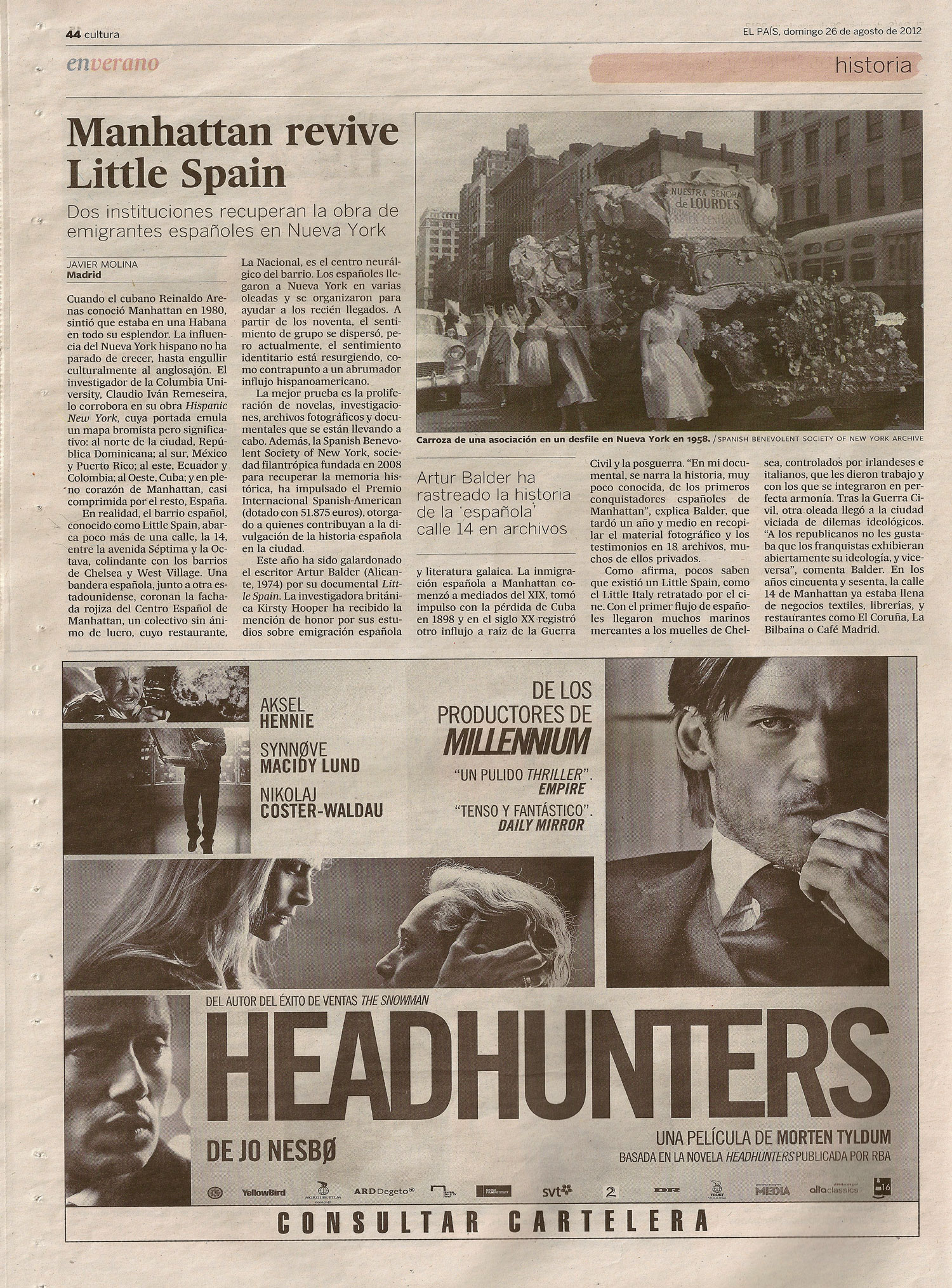
El País, 26 August 2012. Full page.
El País, 26 August 2012 — “Manhattan revive Little Spain” (full page, PDF)
Spain, compressed in the middle of Manhattan
Molina opens with an image borrowed from the Columbia University researcher Claudio Iván Remeseira, whose book Hispanic New York carries on its cover a joke map of the city: to the north, the Dominican Republic; to the south, Mexico and Puerto Rico; to the east, Ecuador and Colombia; to the west, Cuba — and in the very heart of Manhattan, almost squeezed out by the rest, Spain.
That is the argument of the article in one picture. Spanish New York is the oldest of the city’s Hispanic presences and by far the smallest, and it had been almost entirely overwritten. In 2012 the quarter amounted, in Molina’s phrase, to “poco más de una calle, la 14, entre la avenida Séptima y la Octava” — barely more than one street. A Spanish flag beside an American one hung on the reddish façade of the Centro Español de Manhattan, and its restaurant, La Nacional, was described as the nerve centre of what remained.
The waves
The article sets out the emigration in three movements. It began in the middle of the nineteenth century, took on impetus with the loss of Cuba in 1898, and received a further influx in the twentieth century as a result of the Civil War and the years that followed.
With the first of those waves came the merchant seamen, landing at the Chelsea piers — then controlled by the Irish and the Italians, who, in the article’s account, gave them work and alongside whom they settled. That is the same mechanism XL Semanal would describe in 2015, naming the liners that brought them.
The wave that followed the Civil War arrived carrying its politics with it, and the quarter had to absorb both sides of a war at once.
“A los republicanos no les gustaba que los franquistas exhibieran abiertamente su ideología, y viceversa.”
“The Republicans did not like the Francoists displaying their ideology openly, and vice versa.”
Arthur Balder, in El País, 26 August 2012
By the nineteen-fifties and sixties, the article records, 14th Street was full of textile businesses, bookshops and restaurants — El Coruña, La Bilbaína, Café Madrid. The photograph published with the piece shows the float of one of the neighbourhood associations in a New York parade in 1958.
The research, described in 2012
Molina records that the photographic material and the testimonies were gathered across eighteen archives, many of them private — which is why the images in the film are not in circulation anywhere else. See The Archive.
“En mi documental se narra la historia, muy poco conocida, de los primeros conquistadores españoles de Manhattan.”
“My documentary tells the very little-known story of the first Spanish conquerors of Manhattan.”
Arthur Balder, in El País, 26 August 2012
Few people, he told the paper, knew that a Little Spain had ever existed — unlike the Little Italy that the cinema had made famous.
Related
- El País — “Rostros familiares en Nueva York”, 2014
- XL Semanal — “Los españoles que conquistaron Manhattan”
- 14th Street — Calle Catorce
- La Nacional — the Spanish Benevolent Society, 1868–2000
- The Archive
- All press coverage