Robert De Niro on 14th Street
The actor spent part of his childhood at 219 West 14th Street, in a building owned by a Galician — in the middle of Little Spain.
In the nineteen-fifties, after his parents separated, the boy who would become Robert De Niro moved with his mother into a top-floor studio at 219 West 14th Street. The building belonged to José García, a Galician businessman — one of the many Galicians who by then owned property and businesses along that block.
The address matters. 219 West 14th Street is between Seventh and Eighth Avenues: not near the Spanish quarter of Manhattan, but inside it, on its principal block.

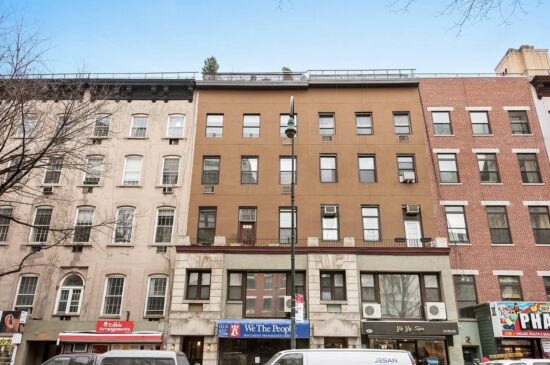
What stood on that block
Number 219 sits on the odd-numbered side of the street. Twenty doors along, at 239, was La Nacional, the Spanish Benevolent Society, founded in 1868 — the social and institutional centre of the colony. Directly across the road at 210 was Casa Moneo, the ultramarinos that had supplied Spaniards across the five boroughs since 1929.
Along the same stretch were the dress shop La Iberia and the restaurants La Bilbaína, Trocadero Valencia, Bar Coruña, Café Madrid, Mesón Flamenco and Restaurante La Coruña. Round the corner stood the church of Nuestra Señora de Guadalupe, where the community was baptised, married and buried in Spanish.
And every summer the street itself closed. The image of Santiago Apóstol was carried down 14th Street in procession, with Spanish food and folklore in the roadway, a custom that continued into the mid-nineteen-nineties. A child living on the top floor of 219 would have watched it pass below the window.
A painter’s household
Both his parents were painters. Virginia Admiral, his mother, was a painter and poet who had studied under Hans Hofmann and moved in the circle that became the New York School; she later ran a typing and transcription business in the Village. Robert De Niro Sr., his father, was a painter of real standing in that same generation, who had shown with Peggy Guggenheim before he was thirty.
They had married in 1942 and separated soon after their son was born in 1943. The 14th Street studio was where mother and son landed afterwards.
The Galician landlord
The story reached print in Galicia. On 6 February 2011 La Voz de Galicia published a piece by Beatriz Pallas under the headline “El casero gallego de Robert De Niro en Nueva York” — Robert De Niro’s Galician landlord in New York — on José García and the building at 219.
It is a small detail that says a great deal about the block. By the nineteen-fifties the Spanish of 14th Street were not newcomers lodging with others; they were the people who owned the buildings, and the future actor’s family were the tenants. Galicians made up the largest share of the colony, many having arrived as merchant seamen who left their ships at the Chelsea piers a few streets west.
None of it is marked today. There is no plaque at 219, and the quarter that surrounded it has gone almost without trace — which is the reason the archive assembled for this film exists at all.
